
Boost Your Speed: 5 Proven Drills That Actually Work for the Remington Layout
You’ve conquered the Mangal Font Remington Gail Keyboard Layout and mastered the Halant ($्$). Now, it’s time to move from accuracy to speed. The difference between a beginner and a certified professional isn’t just knowing where the keys are; it’s the rhythm, muscle memory, and consistency you build through targeted drills.
If you are stuck below 30 WPM (or $5,000 { KPH}), these five unique drills tailored specifically for the positional logic of the Remington layout will help you break through your plateau and achieve exam-ready speeds.
Why Practice Drills Beat Random Typing
Typing random text is inefficient. High-speed typing is achieved by optimizing finger movement for the most frequent character combinations in Hindi. These drills force your fingers to practice those specific high-frequency moves, turning them into instant muscle memory.
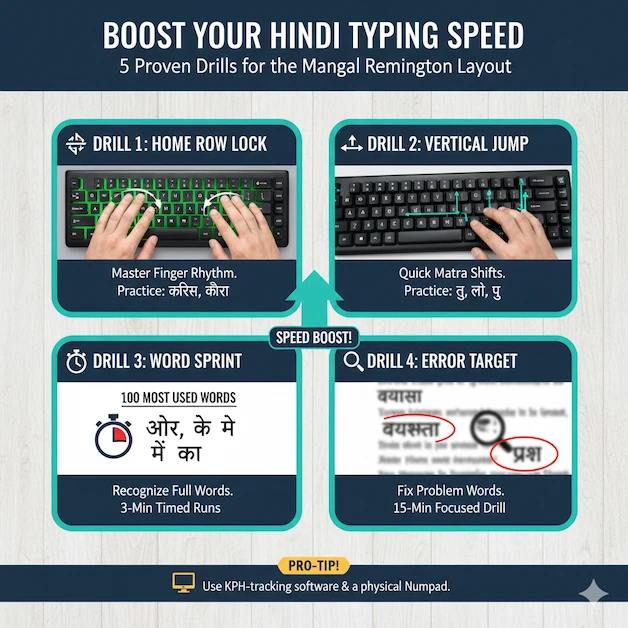
Drill 1: The 'Home Row Lock' for Finger Independence
The Home Row ($अ, े, क, ि, ह, ी, र, ा, स, य$) contains the majority of the most used Hindi characters. This drill forces your fingers to operate independently without looking down or breaking rhythm.
- The Drill: Practice sequences that keep you on or near the home row.
- $करिस$ ($क + र + ि + स$)
- $कीरा$ ($क + ी + र + ा$)
- $हिसक$ ($ह + ि + स + क$)
- $हैरानी$ ($ह + ै + र + ा + न + ी$)
The Goal: Maintain a smooth, even rhythm. Focus on the quick return of the fingers to their base position. Speed comes from the efficiency of the return trip.
Drill 2: Vertical Jumping for Quick Matra Shifts
The Remington layout places the Matras (vowel signs) primarily on the upper and lower rows (e.g., $ु$ on the Q row, $ै$ on the S key with Shift). This drill focuses on the quick vertical jumps between the Home Row and the Matras.
- The Drill: Practice consonant-matra pairs where the matra is not on the Home Row:
- तु (त + ु) →तु → तु
- लो (ल + ो) →लो →लो
- पू (प + ू) →पू →पू
- The Goal: Minimize the pause between the consonant and the matra. Practice $क + ी$, then $क + ु$, then $क + ो$, etc., until all matra jumps feel fluid.
Advanced Speed & Accuracy Techniques
Once you have mastered the basic drills, these techniques focus on bridging the gap between practice and exam performance.
Drill 3: The 100 Most Frequent Hindi Words Sprint
Typing random characters is easy; typing real words is harder. Your speed will plateau if you don’t train your brain to recognize and type entire, high-frequency words as a single unit.
- The Drill: Get a list of the 100 most common words in Hindi (e.g., $और, है, के, में, का, पर, यह$). Set a timer for three minutes and type the list repeatedly.
- The Goal: Do not pause to read the word; train your eyes and fingers to recognize the shape of the entire word and execute the keystrokes automatically. Aim to type the entire list three times within the limit.
Drill 4: Error Correction Only (Targeted Accuracy)
- The Drill:
- Take a 5-minute timed mock test.
- Review the result and identify the five words you mistyped the most (e.g., $स्मृति, व्यवस्था, प्रकाश$).
- Spend the next 15 minutes typing only those five words, focusing on absolute 100% accuracy. Type each one 50 times.
- The Goal: By the end of the session, those five problem words should become muscle memory, effectively removing them from your ‘error vocabulary.’
Drill 5: The Endurance Test (20-Minute Timed Session)
The Drill: Set up a full-length, 20-minute timed test using dense, complex Hindi paragraphs. A pro tip for finding content: take official court or government documents (often found in legacy fonts), run a quick krutidev to unicode conversion, and paste the clean text into your typing tutor. Do this once per day in the week leading up to your exam.
- The Drill: Set up a full-length, 20-minute timed test using dense, complex Hindi paragraphs. Do this once per day in the week leading up to your exam.
- The Goal: Focus on rhythm over speed. If you start to panic or slow down, take a deep breath and reduce your speed slightly to regain your consistent rhythm. Consistent $30 WPM is better than bursts of $40 WPM followed by a $10 WPM crawl.
Finding the Right Practice Tools
You must practice using software that mimics the exam environment, including supporting the Mangal Remington Gail layout and calculating KPH.
- Recommended Software (Check for current versions):
- Mahesh Typing Tutor (Known for excellent Remington support)
- Soni Typing Tutor
- Typing Guru
- Key Feature to Check: Ensure the software allows you to disallow or penalize the backspace key, as many exams restrict or penalize its use.
Start with these focused drills today. Remember, consistency is more important than duration. Even 45 minutes of targeted practice daily will dramatically increase your speed and secure your success in the typing exam!
Ready to start your exam prep? Make sure you know exactly what is expected in your test by reading our guide: The CPCT Blueprint: How to Pass the Hindi Typing Test Using Mangal Remington.
Thanks for sharing