
If you’re preparing for a state-level exam like the CPCT (Computer Proficiency Certification Test), or central exams like the SSC CHSL or High Court recruitment, your Hindi typing speed and accuracy using the Mangal Font Remington Gail Keyboard will be heavily tested.
This blueprint cuts through the confusion and provides a straightforward, 30-day plan focused purely on meeting and exceeding the mandatory speed and accuracy requirements of these competitive exams.
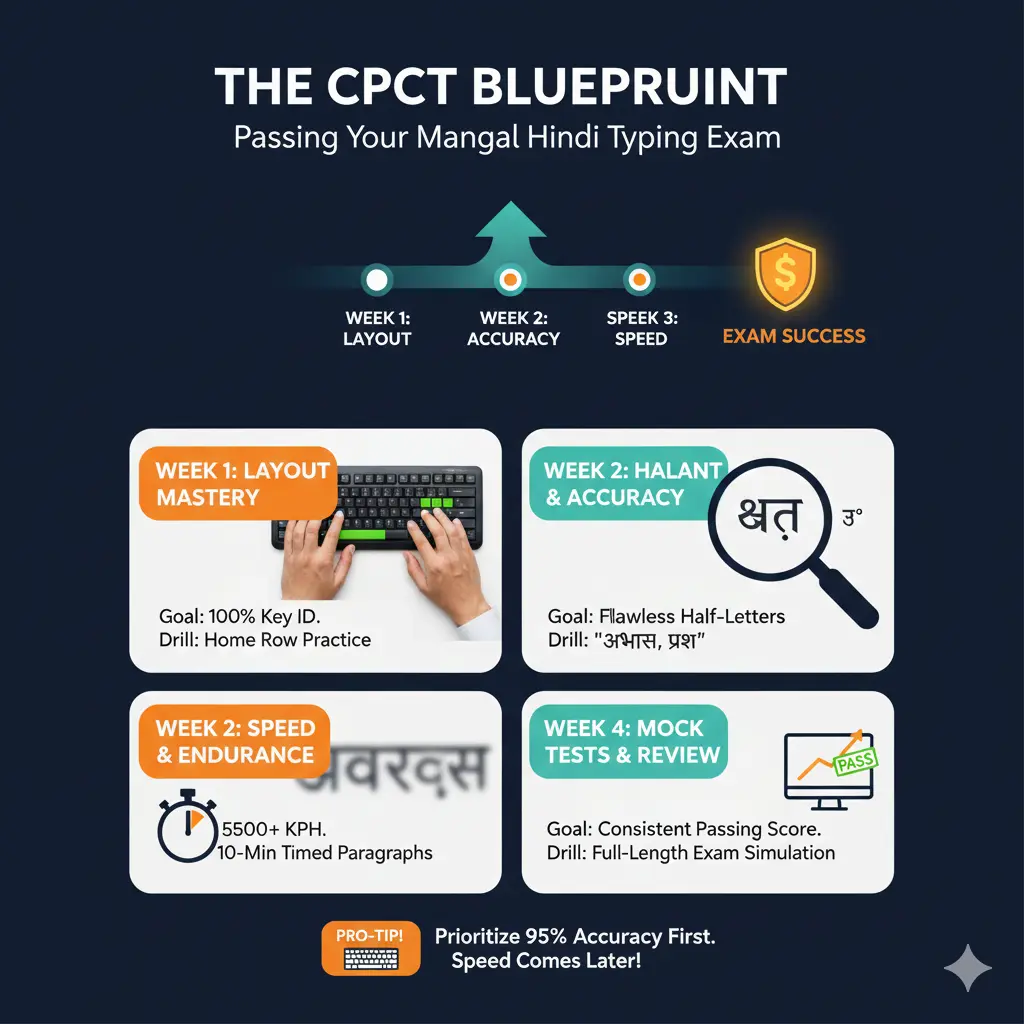
Understanding the Hindi Typing Requirement
Before you begin practicing, you must understand how your speed is measured, as this dictates your practice strategy.
WPM vs. KPH: The Crucial Metric for Mangal Typing
While English exams often measure in Words Per Minute (WPM), many official Hindi exams calculate your speed in Key Depressions Per Hour (KPH).
- WPM (Words Per Minute): This is often a rough estimate, as Hindi words vary greatly in length.
- KPH (Key Depressions Per Hour): This is the official standard for accuracy. It counts every single keypress (letters, Halants, matras, spacebar, etc.) made correctly in the allotted time.
CPCT Standard Example: The typical passing requirement for Hindi typing is usually around 20 WPM or 5,000 KPH. Your goal must be to comfortably exceed this during practice (aim for $7,000 \text{ KPH}$) to account for exam stress.
Accuracy and Error Calculation: The 90% Trap
Passing isn’t just about speed; it’s about accuracy. Exams typically require a minimum of 85% to 90% net accuracy.
- Gross Speed: The total number of keystrokes you made.
- Net Speed: Gross Speed minus penalties for mistakes (incorrect characters, omissions, extra characters).
- The Penalty: If you make too many errors, your high gross speed will be penalized down to a failing net speed. Prioritize 95%+ accuracy over raw speed for the first two weeks.
Your 30-Day Remington Gail Practice Schedule
This structured plan assumes you know the basic QWERTY keyboard but are new to the Mangal Remington layout.
Week | Focus Area | Goal | Key Practice Drills |
Week 1 | Layout Mastery & Muscle Memory | 100% accurate identification of all keys (Normal and Shifted). | Home Row Drills: Practice sequences using only the keys $क, ि, र, ह, ा, स, ए$. Single Character Typing: Drill each key $क \rightarrow ख \rightarrow ग$, etc., 10 times. |
Week 2 | Accuracy and The Halant ($्$) | Comfortably execute the Halant rule for all half letters ($स्म, क्त, न्न$). | Halant-Heavy Words: Practice words like $अध्यापक, व्यवस्था, प्रश्न$. Rakar/Reph Drills: Focus 15 minutes daily on words like $प्रकाश, धर्म, ट्रेन$. |
Week 3 | Speed Building & Endurance | Achieve sustained speed without looking at the keyboard (touch typing). | Timed Paragraphs (5 Min): Type full, diverse Hindi paragraphs with simple punctuation. Focus on Rhythm: Maintain a smooth, consistent rhythm rather than short bursts of speed. |
Week 4 | Mock Tests & Exam Simulation | Consistently pass timed tests with required KPH and accuracy (90% minimum). | Full Mock Tests (10-15 Min): Simulate the exact exam environment. Review Mistakes: Analyze every failed test, isolate the problem words, and drill them specifically. |
Advanced Speed & Accuracy Techniques
Once you hit 3000 KPH, you need specialized techniques to push toward the $5000-7000 KPH range.
Eliminate the Pause on Matras and Shift Keys
Beginners often pause when reaching for a Matra ($ा, ी, ु$) or a Shift key ($क्ष, त्र, ज्ञ$).
The Solution: Treat the Matra keys and the Shift key as part of the letter itself. For example, to type $की$ (kee), practice the sequence $क \rightarrow \text{shift} + \text{D}$ as one continuous motion, not two separate ones.
The Finger Mapping Check
If you are stuck at a certain speed, you are likely using the wrong fingers for specific keys.
- The Home Row Rule: Ensure your fingers are always returning to the Home Row ($अ, े, ि, क, ह, ी, र, ा, स, य$) immediately after pressing a key.
- Targeted Drills: If you consistently struggle with $र$ (J key), drill the movement from the Home Row to the J key 100 times until it becomes subconscious.
Prioritize Accuracy Over Everything (Initially)
It’s better to type at 20 WPM with 98% accuracy than 35 WPM with 80% accuracy. Why? Because correcting a deep-seated error is harder than simply speeding up an accurate habit. Speed will come naturally once accuracy is mastered.
Exam Day Preparation Checklist
Don’t let technical issues ruin months of preparation.
Software Check: Ensuring You Have the Right Remington Gail Keyboard
- Crucial Step: One day before the exam, confirm your system is running the Mangal Font (Unicode) and the Remington/Gail layout (labeled as “Hindi Traditional” in Windows). Do not rely on phonetic typing systems unless specifically instructed.
H3: Final Test Day Tips
- Read Ahead: If the test allows, read the first three to five words of the paragraph before you begin typing.
- Focus on the Text, Not the Screen: Only glance at the screen to check your progress. Keep your eyes primarily on the source text to minimize errors.
- Stay Calm: The biggest performance killer is panic. If you make an error, breathe, correct it quickly, and immediately regain your rhythm.
By following this CPCT Blueprint, you shift from merely practicing to strategically training for success. Now, start those drills!
Need help with those tricky Rakar and Reph keys? Check out our dedicated guide: The Unwritten Rules of the Halant ($्$)!